

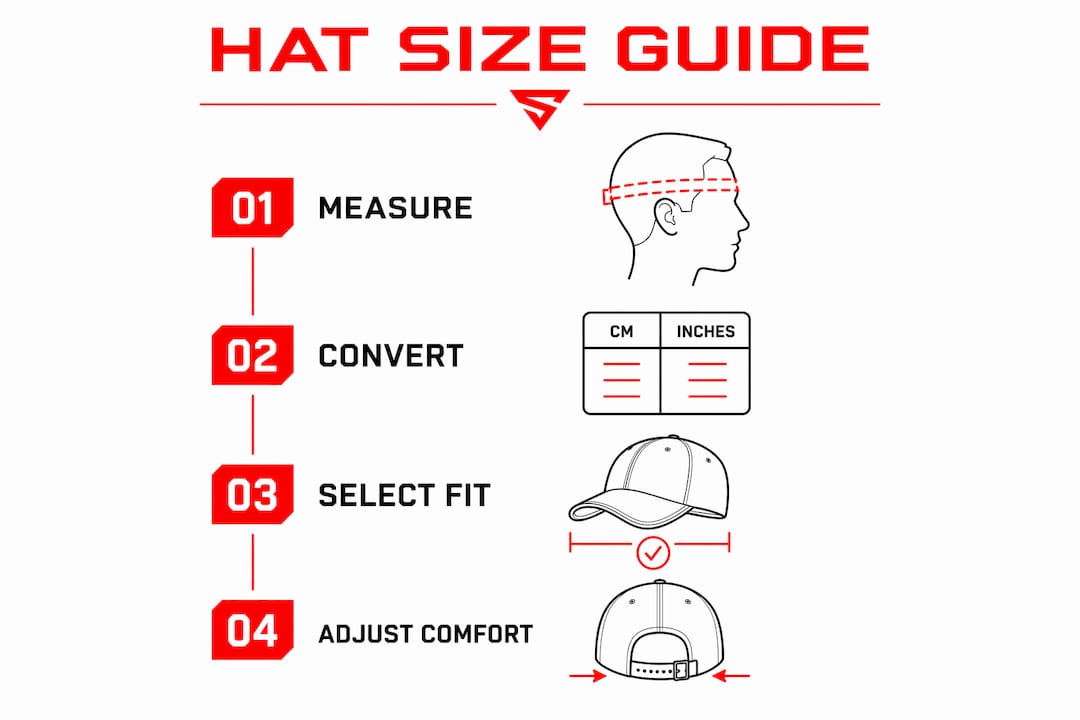
To measure your hat size, wrap a flexible fabric tape measure around the widest part of your head, positioned about 1/2 to 1 inch above your ears and eyebrows. Keep the tape snug enough to stay in place but loose enough to slide one finger underneath. Read the number where the tape overlaps, and record it in both inches and centimeters. That single measurement is the foundation of every hat size you’ll ever need.
Here’s the full process, step by step:
- Get a soft fabric tape measure. The kind used for sewing follows the curve of your head. A stiff ruler won’t work.
- Position the tape correctly. Start at the center of your forehead, about 1/2 inch above your eyebrows, then wrap it around just above your ears and across the widest point at the back of your skull.
- Keep it level. The tape should sit flat all the way around, not tilted or angled down at the back.
- Check the snugness. You should be able to slide one finger under the tape without forcing it. Tighter than that, and you’ll order a hat that gives you a headache by noon.
- Read and record. Note the measurement in inches and centimeters. Most US sizing charts use inches; EU charts use centimeters.
- Repeat twice more. Take three separate readings and average them. Tape placement shifts slightly between attempts, and averaging smooths out that error.
Pro Tip: If you have thick hair or plan to wear a hat liner in winter, consider adding a small amount to your final measurement before consulting a size chart. Hair compresses under a hat, but not always as much as you’d expect.
Table of Contents
- How do you convert your head measurement into a hat size?
- Tips for getting an accurate, comfortable measurement
- Why hat sizing varies and why one measurement isn’t always enough
- Serpens hats: sized right, styled for real life
- Key Takeaways
How do you convert your head measurement into a hat size?
Once you have your circumference in inches, finding your US hat size is straightforward. The US system uses fractional numbers like 6 7/8, 7, and 7 1/4, each tied to a specific head circumference. The gap between consecutive sizes is small, so precision matters.

The table below maps common head circumferences to US hat sizes and general alpha labels. These figures apply to both men’s and women’s hats, though women’s styles occasionally run a half-size smaller in fitted caps.
| Head Circumference (inches) | Head Circumference (cm) | US Hat Size | Alpha Size |
|---|---|---|---|
| 21 1/8" | — | 6 7/8 | XS |
| 21 1/2" | — | 6 7/8 | S |
| 22" | — | 7 | M |
| 22 1/2" | — | 7 1/8 | M |
| — | — | 7 1/4 | L |
| — | — | 7 1/4 | L |
| 24" | — | 7 1/2 | XL |
| 24 1/2" | — | 7 1/2 | XXL |
If your measurement falls between two rows, it is recommended to go with the larger size. A hat that’s slightly big can be adjusted with sweatband inserts; one that’s too small has nowhere to go.
Fitted vs. adjustable vs. stretch hats. This distinction changes how strictly you need to follow the chart. Fitted hats require exact sizing since there’s no mechanism to compensate. Adjustable styles, like snapbacks and strapbacks, typically span a range of about 21–24 inches, so a precise measurement matters less. Stretch hats, common in beanies and some athletic caps, use S/M/L labels that cover a range of circumferences, making them the most forgiving of the three.

The EU sizing system is worth knowing if you shop internationally. It uses centimeters directly: a 58 cm head wears a size 58. No conversion formula needed. UK sizes follow their own fractional system, slightly different from US numbers, so always check the brand’s chart rather than assuming a US 7 1/4 equals a UK 7 1/4. It doesn’t.
Tips for getting an accurate, comfortable measurement
Measurement accuracy isn’t just about technique. A few practical habits separate a hat that fits from one that sits in a drawer.
- Measure with your hair as you’ll actually wear it. If you usually wear your hair down, measure it down. Thick natural hair or a high bun can add several centimeters of volume. Recording measurements with hair styled and hair flattened gives you two reference points, which is useful when choosing between a fitted cap and a beanie.
- Use a mirror or ask someone for help. Keeping the tape perfectly level while reading the number solo is harder than it sounds. A second set of eyes catches a tilted tape before it costs you a return shipment.
- Don’t measure at the brow line. Placing the tape directly across your eyebrows instead of 1 cm above them typically underestimates head size, which is enough to push you into the wrong size.
- When in doubt, size up. Choosing the larger size between two is standard practice. Padding behind the sweatband can close a small gap; nothing fixes a hat that’s too tight.
- No tape measure? Use string. Wrap a piece of non-stretch string around your head at the correct position, mark where it overlaps, then lay it flat against a ruler. You get the same number a tape would give you.
Pro Tip: If you already own a hat that fits well, check its interior label for the size number, then cross-reference it with a sizing chart. That gives you a reliable baseline without measuring at all, especially useful for gift shopping.
Fit also depends on why fit matters beyond the number. Head shape, crown depth, and brim width all affect how a hat actually sits, which is why two people with identical circumferences can have very different experiences in the same hat.
Why hat sizing varies and why one measurement isn’t always enough
The US hat sizing system has a quirky history. The numbers, like 6 7/8 or 7 1/4, were originally derived from the internal diameter of the hat, not the circumference of the wearer’s head. That legacy means US sizes use fractions tied to internal diameter, which is why the math doesn’t feel intuitive when you’re holding a tape measure showing 22 inches.
Brand-to-brand variation makes this worse. A size 7 from one manufacturer may fit noticeably differently from a size 7 from another, because there’s no enforced global standard. Always check the specific brand’s size chart before ordering, especially from international sellers.
Beyond circumference, several factors shape how a hat actually fits:
- Hair thickness and season. A winter wool liner or a full head of thick curls can add meaningful volume inside the crown.
- Hat style. A structured fedora with a firm brim fits differently than a relaxed flat cap or a knit beanie, even at the same labeled size. Crown depth varies significantly across styles.
- Head shape. Oval, round, and long head shapes interact differently with hat crowns. Some brands offer styles cut for specific shapes, though this is more common in premium fitted caps.
- Adjustable features. Snapbacks, strapbacks, and fitted stretch bands each handle the circumference-to-fit translation differently. An adjustable hat is more forgiving of a measurement that’s slightly off.
Taking multiple measurements, accounting for hair, and checking brand-specific charts isn’t overkill. It’s the difference between a hat you wear constantly and one that never quite feels right.
Serpens hats: sized right, styled for real life

You’ve done the measuring. Now the fun part: finding a hat worth wearing. Serpens carries branded caps and lifestyle hats built for people who actually wear their gear, not just collect it. The aesthetic is bold and clean, the kind of hat that works with a raglan tee on a Saturday or a hoodie on a Tuesday.
Every Serpens hat comes with clear sizing information so the number you just measured translates directly to the right fit. No guessing, no returns because the size chart was vague. Whether you’re after a structured cap or something more relaxed, the sizing is consistent across the collection.
Head to Serpens and shop the hat lineup now.
Key Takeaways
Measuring your head circumference correctly, averaging three readings, and cross-referencing a brand-specific size chart are the three steps that eliminate almost every bad hat purchase.
| Point | Details |
|---|---|
| Tape placement matters | Position the tape about 1/2 to 1 inch above your ears and eyebrows, at the widest point of your head. |
| Take three readings | Average three separate measurements to account for tape placement variation and reduce error. |
| Adjust for hair and liners | Add 0.5 to 1 cm if you have thick hair or plan to wear a winter liner inside the hat. |
| Size up when between sizes | A slightly larger hat can be adjusted with sweatband padding; a too-small hat cannot be stretched. |
| Serpens hats | Serpens offers branded caps with consistent sizing, so your measured circumference maps cleanly to the right fit. |